
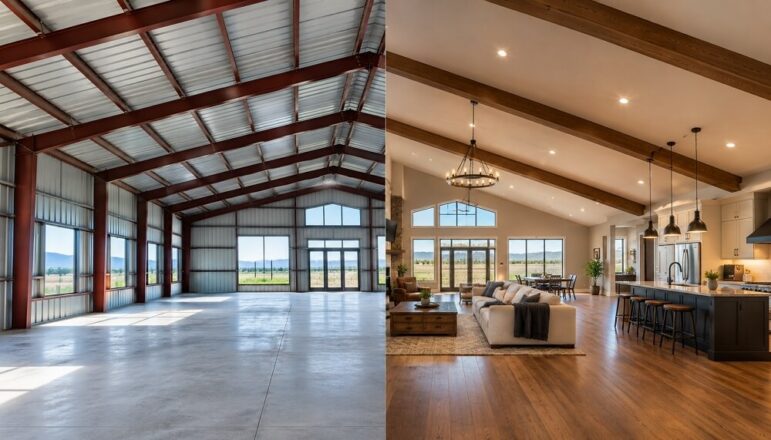
The rise of the barndominium has reshaped the landscape of modern home building. Offering a blend of rustic charm, structural resilience, and open-concept potential, these metal-framed or post-frame structures have moved from niche rural housing to a mainstream construction trend. However, as interest grows, so does the confusion surrounding the terminology used by builders and sellers.
One of the most critical distinctions a prospective buyer must understand is the difference between purchasing a “shell” and purchasing a “turnkey” package. The gap between these two options is vast, impacting everything from budget and timeline to the level of personal involvement required.
Understanding these two paths is essential for anyone looking to break ground on a barndominium project.
Defining the Barndominium Shell
A barndominium shell—often referred to as a “dry-in” or “shell package”—represents the structural foundation of the project. When a buyer purchases a shell, they are essentially acquiring the skeleton of the building. The goal of this phase is to get the structure to a point where it is protected from the elements and structurally sound.
A typical shell package generally includes:
- Foundation and Slab: The concrete work required to support the structure.
- Erection of the Frame: The steel beams or wooden posts that form the primary structure.
- Roofing: The metal roof panels and insulation (sometimes).
- Exterior Walls: The metal siding or sheathing.
- Windows and Exterior Doors: Installed to “dry in” the building.
What a shell does not include is the interior finish-out. Once the shell is complete, the buyer is left with a large, open, weather-tight space that resembles an empty warehouse. There is no plumbing, no electrical wiring, no HVAC system, no interior framing (studs for bedrooms/bathrooms), and no drywall.
Purchasing a shell is often the choice for those who want to act as their own general contractor (GC) or those who have a specific vision for the interior that requires specialized trades not offered by the shell erector.
Defining the Turnkey Barndominium
A turnkey barndominium is the antithesis of the shell. The term “turnkey” implies that upon completion, the owner simply needs to “turn the key” in the lock and move in. This is a full-service construction package where the builder handles every aspect of the project from start to finish.
In a turnkey scenario, the builder manages:
- Design and Engineering: Architectural plans and structural engineering.
- Permitting: Handling the bureaucracy of local building codes.
- Site Work: Clearing, grading, and utilities trenching.
- The Shell: Everything mentioned in the previous section.
- Interior Finishes: Framing, insulation, drywall, painting, and flooring.
- Mechanical Systems: HVAC, electrical, plumbing, and septic/sewer connection.
- Fixtures and Finishes: Cabinets, countertops, light fixtures, and appliances.
The turnkey approach transforms the barndominium from a steel skeleton into a fully functional living space. The primary advantage here is convenience. The builder assumes the risk of coordinating subcontractors, managing timelines, and ensuring the project meets code requirements.
The Core Differences: A Comparative Analysis
To determine which route fits a specific project, one must weigh the key differences between these two approaches.
- Cost and Budgeting
The sticker price of a shell is significantly lower than that of a turnkey build. However, the total cost of a shell-built home is often unpredictable. While the shell price is fixed, the cost of interior finishes depends heavily on material selection and labor rates at the time of installation. With turnkey, the price is typically locked in (or estimated with allowances) from the outset, offering better financial predictability, albeit at a higher initial number.
- Time and Timeline
A shell can be erected in a matter of weeks or a few months. This appeals to those who need a structure up quickly for storage or agricultural use while planning the residential conversion later. A turnkey build takes considerably longer—often six to twelve months or more—due to the sequential nature of interior trades.
- Management and Responsibility
This is the dividing line. With a shell, the owner becomes the project manager. They must hire plumbers, electricians, HVAC technicians, and drywallers. They are responsible for scheduling these trades so they do not overlap incorrectly or delay one another. With turnkey, the builder handles all scheduling and quality control.
- Financing
Financing a shell can be tricky. Many traditional mortgage lenders are hesitant to finance a structure that is not yet habitable. Construction loans are often required, which have higher interest rates and shorter terms. Turnkey builds are easier to finance because they result in a finished, appraisable asset that qualifies for standard mortgage products.
- Customization vs. Convenience
A shell offers maximum customization. The owner can place walls, plumbing, and electrical outlets exactly where desired without negotiating with a builder’s standard floor plan. Turnkey offers convenience. The trade-off for handing over the reins is often a limitation to the builder’s pre-approved floor plans and material selections.
Which Option is Right?
The decision between shell and turnkey depends entirely on the resources, skills, and timeline of the buyer.
A shell is likely the best choice if:
- The buyer has extensive construction knowledge or experience as a GC.
- The buyer has a network of reliable subcontractors.
- The buyer wants to save money by doing sweat equity (doing some work personally).
- The project is being built in phases (e.g., living in a portion while finishing the rest).
A turnkey build is likely the best choice if:
- The buyer values time and convenience over managing a job site.
- The buyer has a clear, fixed budget and wants to avoid the stress of cost overruns.
- The buyer lacks construction experience and does not want to manage subcontractors.
- The buyer needs a traditional mortgage to finance the project.
Conclusion
The choice between a barndominium shell and a turnkey build is a choice between control and convenience. The shell route offers a path to significant savings and total creative freedom, but it demands a high tolerance for stress and a deep understanding of construction logistics. The turnkey route provides a seamless, stress-free experience and a move-in-ready home, but it comes at a premium price and typically offers less flexibility during the design phase.
Ultimately, the right choice is the one that aligns with the financial capabilities and lifestyle of the individual builder.