
Barndominiums have surged in popularity for good reason. They offer a unique blend of rustic charm, open-concept living, and structural durability that traditional stick-built homes often struggle to match. However, because these structures are essentially metal shells, the approach to insulation is different—and often more critical—than in a standard house.
Unlike a traditional home with wood framing and drywall, a barndominium requires a thermal barrier that can handle the specific challenges of a metal building. This includes preventing condensation, managing radiant heat, and sealing out air drafts. Consequently, the cost to insulate a barndominium is a significant line item in the construction budget.
Understanding the variables that affect pricing is essential for accurate financial planning. Here is a breakdown of what drives the cost and what homeowners can expect to pay.
The Primary Cost Drivers
There is no single “one-size-fits-all” price tag for insulating a barndominium. The final figure is determined by a combination of factors:
- Square Footage and Layout
The most obvious factor is the size of the home. A smaller 1,000-square-foot guest house will cost significantly less than a sprawling 4,000-square-foot custom shop/house combo. Additionally, the layout matters; complex rooflines, lofts, and vaulted ceilings require more material and labor than a simple open floor plan.
- Insulation Type
The material chosen plays a massive role in the budget. Standard fiberglass batts are the most budget-friendly but may not perform well in a metal building environment due to moisture risks and air gaps. Spray foam is more expensive but offers superior airtightness and structural stability.
- Climate Zone
The geographic location determines the R-value (thermal resistance) required by local building codes. A barndominium in Texas requires a different insulation strategy and thickness than one in Minnesota. Higher R-values require thicker material or different application techniques, increasing the cost.
- Labor vs. DIY
While some owners attempt to insulate their own barndominiums, professional installation is highly recommended for spray foam and rigid board applications. Labor costs can account for 40% to 60% of the total project price.
Cost Breakdown by Insulation Method
To determine a realistic budget, it helps to look at the three most common methods used in barndominium construction.
Spray Foam Insulation
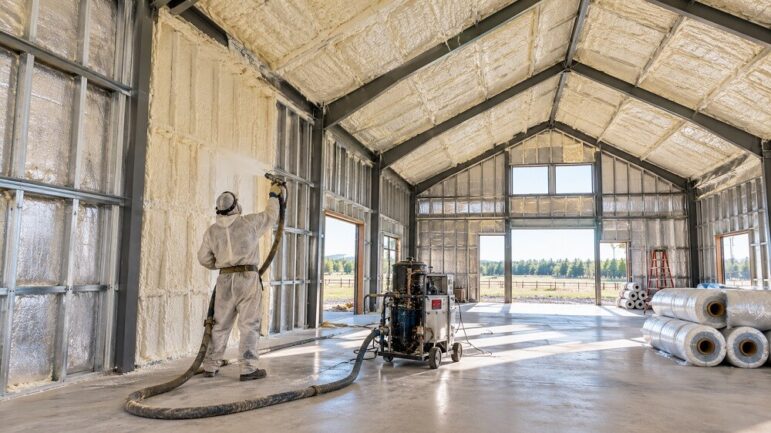
Spray foam is widely considered the gold standard for metal buildings. It expands to fill every crack and crevice, creating a seamless air barrier and preventing condensation on the metal panels.
- Open-Cell Spray Foam: This is softer and less dense. It is excellent for sound dampening and costs roughly $0.75 to $1.25 per square foot.
- Closed-Cell Spray Foam: This is the most expensive option at $1.50 to $2.50 per square foot. It is rigid, adds structural strength, and acts as a vapor barrier. For a typical barndominium, closed-cell foam is usually the preferred choice for the exterior shell.
Estimated Total: For a 2,000-square-foot home, professional spray foam insulation could range from $6,000 to $12,000.
Fiberglass Batts
Fiberglass is the traditional, economical choice. However, in a metal building, batts require a perfectly sealed cavity to work effectively. If air leaks through the metal siding, the fiberglass loses its R-value.
- Cost: Roughly $0.50 to $1.00 per square foot installed.
Estimated Total: For a 2,000-square-foot home, fiberglass batts might cost between $2,500 and $5,000. However, this lower upfront cost might be offset by higher energy bills if the installation is not meticulous.
Rigid Foam Board
This is often used in conjunction with batts or as a continuous exterior layer. It is an effective way to prevent thermal bridging (where heat transfers directly through the metal framing).
- Cost: Roughly $0.75 to $1.50 per square foot.
Estimated Total: For a 2,000-square-foot home, rigid board installation might range from $3,500 to $7,000.
The Hidden Cost: Vapor Barriers and Ceilings
When budgeting, do not overlook the ceiling and the vapor barrier.
Barndominiums often feature high, vaulted ceilings. Insulating an open rafter ceiling is more labor-intensive than insulating a flat attic floor. The cost to insulate the roof deck alone can be 30% to 40% of the total insulation budget because it requires more material and careful application to prevent ice dams and condensation.
Furthermore, a robust vapor barrier is non-negotiable in metal buildings. Without it, warm moist air from the interior will hit the cold metal and condense, leading to rust and mold. While the vapor barrier material itself is relatively inexpensive (often just heavy-duty polyethylene), the labor to seal every seam and penetration adds to the bottom line.
Potential Savings and ROI
While the initial price tag for a barndominium insulation project can be daunting—with a full range often landing between $3.00 and $7.00 per square foot depending on the method—it is important to view this as an investment.
A properly insulated barndominium:
- Lowers monthly HVAC bills dramatically.
- Keeps the interior temperature stable, even in extreme weather.
- Prevents moisture damage and rust to the steel structure.
- Reduces noise from rain and hail on the metal roof.
Conclusion
Insulating a barndominium is not a place to cut corners. The specific nature of a metal shell means that inferior insulation or poor installation can lead to condensation, rust, and skyrocketing energy costs. A realistic budget for a standard-sized home should allocate between $8,000 and $15,000 for a high-quality insulation package including materials and professional labor.
Because prices fluctuate based on region and material availability, obtaining multiple quotes from contractors who specialize in metal building insulation is the best way to secure an accurate estimate for a specific project.